
Factory-direct OEM/ODM certified aesthetic hardware engineered for high-throughput medspas and global distributors.
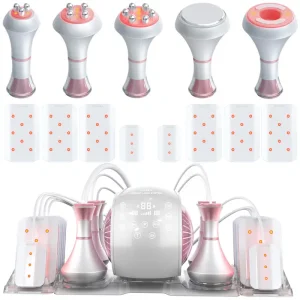
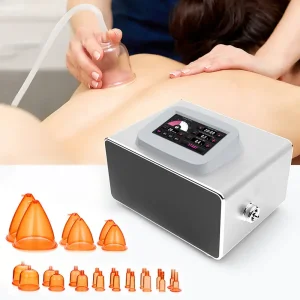
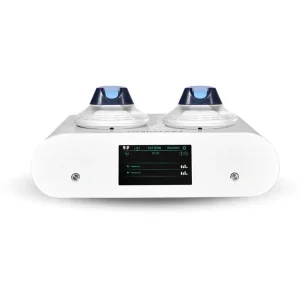
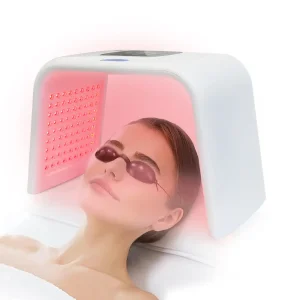
Analysis of global market trajectories, procurement criteria, and ROI expectations driving commercial laser facial machine acquisitions across tier-1 medical spas, dermatology chains, and aesthetic distributors.
Shifts in Commercial Procurement Intent
The global demand for high-performance laser facial systems has evolved from basic hair removal and non-ablative rejuvenation to complex multi-wavelength, targeted photothermolysis platforms. Enterprise buyers—including regional medical device importers, clinical franchise groups, and aesthetic equipment brand owners—require hardware that balances clinical efficacy with operational safety and zero-downtime reliability.
Key purchasing drivers are no longer dictated solely by peak wattage, but rather by pulse-width stability, energy calibration accuracy, diode stack durability (surpassing 50 million shots), and localized compliance certifications (such as ISO 13485, CE MDR, and FDA clearance).
OEM/ODM Manufacturing Imperatives
For distributors looking to establish market dominance, sourcing directly from audited custom laser facial machine suppliers offers significant strategic leverage. Direct factory partnerships eliminate middleman margins, enabling superior Gross Margin Return on Investment (GMROI) while allowing bespoke software user interface (UI) design, customized housing aesthetics, ergonomic handpiece design, and tailored laser spot sizes.
Factories operating with complete end-to-end R&D infrastructure ensure that firmware can be updated to include localized treatment protocols tailored to specific patient demographics across North America, Europe, Asia-Pacific, and the Middle East.
A comparative clinical breakdown of optical wavelengths, thermal relaxation profiles, energy delivery mechanics, and primary aesthetic indications.
Picosecond & Q-Switched Nd:YAG (1064nm / 532nm)
Operating in the picosecond domain ($10^{-12}$ seconds), these systems utilize photo-acoustic pressure waves rather than pure photothermal energy. This shatters epidermal hyperpigmentation and dermal ink without damaging surrounding tissue.
- Target Chronophores: Melanin, Hemoglobin, Tattoo Pigment.
- Clinical Scope: Melasma, Nevus of Ota, Carbon Laser Peel, Post-Inflammatory Hyperpigmentation (PIH).
- Spot Size Adjustment: 2mm to 10mm continuous zoom.
Diode Laser Facial Systems (808nm / 755nm / 1064nm)
Utilizing micro-channel or non-channel semiconductor laser stacks, diode facial machines target deep follicular melanin and micro-vascular networks with constant thermal pulse delivery.
- Cooling Technology: Sapphire Contact TEC Cooling down to $-10^\circ\text{C}$.
- Fluence Range: Up to $120\,\text{J/cm}^2$ with variable pulse durations ($10\text{--}400\,\text{ms}$).
- Clinical Scope: Facial hair removal, acne vulgaris mitigation, vascular tone improvement.
Fractional CO2 & Erbium Glass (10600nm / 1550nm)
Creates Microscopic Thermal Zones (MTZs) in dermal tissue, triggering robust neocollagenesis and elastic fiber restructuring for severe photo-aged skin and structural acne scars.
- Mode Options: Ultra-Pulse, Fractional Scanner, Surgical Cutting.
- Scanner Patterns: Square, Rectangle, Circle, Triangle, Custom Hexagon.
- Clinical Scope: Deep wrinkle ablation, scar resurfacing, pore contraction, collagen remodeling.
| Laser Tech Modality | Wavelength Range | Pulse Duration | Primary Biological Chromophore | Safety Profile (Fitzpatrick I-VI) | OEM Unit Production Lead Time |
|---|---|---|---|---|---|
| Picosecond Nd:YAG | 1064nm / 532nm (755nm optional) | 450ps – 750ps | Melanin / Exogenous Ink | High (Safe for Fitzpatrick I-VI) | 14 – 21 Working Days |
| Diode Laser Matrix | 755nm / 808nm / 940nm / 1064nm | 1ms – 400ms | Melanin / Oxyhemoglobin | Very High (Contact Cooling Dependent) | 10 – 15 Working Days |
| Fractional CO2 | 10600nm RF Metal Tube | 0.1ms – 10ms | Intracellular & Extracellular Water | Moderate (Fitzpatrick I-III Preferred) | 18 – 25 Working Days |
| Erbium YAG / Glass | 2940nm / 1550nm Non-Ablative | 0.5ms – 20ms | Tissue Water Spectrum | High (Low post-treatment downtime) | 15 – 20 Working Days |
How direct custom laser facial machine manufacturers take your proprietary aesthetic concept from CAD prototyping to clinical batch delivery.
Optical & Mechanical Architecture
Engineering the laser cavity, selecting optical lenses (quartz vs. sapphire), designing custom injection-molded casings, and running thermodynamic simulations to guarantee continuous energy dispersion without overheating.
PCB Firmware & GUI Development
Coding proprietary Android/Linux touchscreen user interfaces, integrating multi-language support, implementing patient treatment memory banks, and establishing smart RF-ID handpiece protection systems.
Quality Inspection & Burn-in Testing
Every unit undergoes continuous 72-hour pulse stress tests, laser power meter energy output verification, insulation voltage safety checks, and vibration testing to endure international freight.
Navigating complex international medical device frameworks to guarantee seamless customs clearance, legal clinic deployment, and local service continuity.
International Quality Certification Standards
Commercial aesthetic lasers must adhere to strict electromechanical and biological safety guidelines. Top-tier manufacturers maintain ISO 13485 quality management systems specifically for medical devices. When importing laser facial equipment into key global territories, buyers must verify:
- European Union: CE MDR (Medical Device Regulation 2017/745) compliance, EN IEC 60601-1 electrical safety, and EN IEC 60601-2-22 laser equipment safety.
- United States: FDA 510(k) clearance pathways, Laser Notice No. 50 compliance, and CDRH accession number documentation for custom optical emitters.
- Rest of World: ANVISA (Brazil), TGA (Australia), and Health Canada medical device license compatibility.
Localized Support & Spare Parts Infrastructure
Unplanned equipment downtime directly damages clinical revenue. A robust B2B manufacturing partner provides comprehensive post-sale infrastructure to protect your operational investments:
- Modular Component Swap: Plug-and-play power supply, water pump, and laser driver boards for rapid local repair.
- Technical Training Kits: Complete maintenance manuals, video tutorials, and live engineer tele-support for distributor service technicians.
- Warranty & Part Availability: Guaranteed availability of OEM optics, flash lamps, and cooling filters for at least 7 years post-production.
The convergence of artificial intelligence, real-time skin diagnostics, and autonomous energy modulation in modern laser facial hardware.
AI Skin Impedance Sensing
Integrated optical sensors automatically read epidermal melanin density, hydration levels, and tissue impedance prior to pulse discharge, auto-calculating optimal fluence ($J/cm^2$) to eliminate operator error and prevent burns.
IoT Remote Diagnostics
Cloud-connected smart machines enable factory technicians to run remote diagnostic scans, monitor shot counts, detect early cooling system pressure drops, and deploy over-the-air (OTA) firmware updates seamlessly.
Multi-Wavelength Synthesis
Future handpiece optical designs combine simultaneous emission of 755nm, 808nm, and 1064nm wavelengths in a single synchronized delivery window, treating multi-depth dermal structures concurrently.
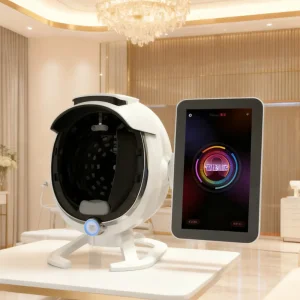
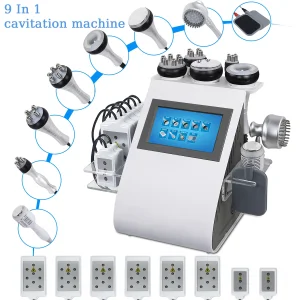
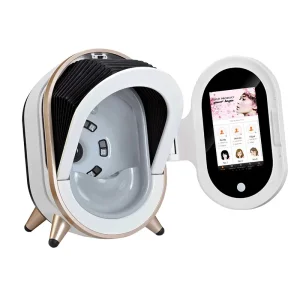
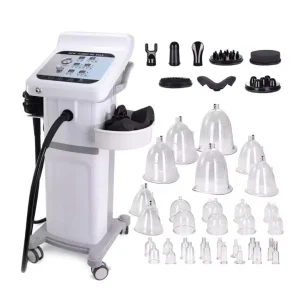
Comprehensive diagnostic analyzers, mesotherapy systems, and specialized body shaping equipment engineered for immediate deployment.
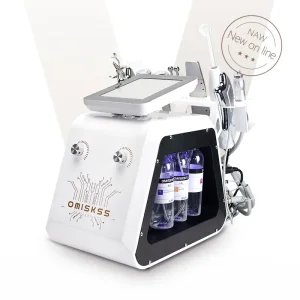
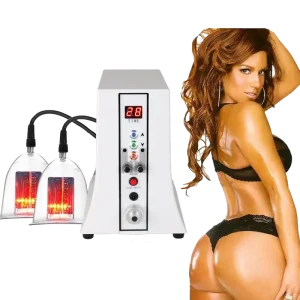
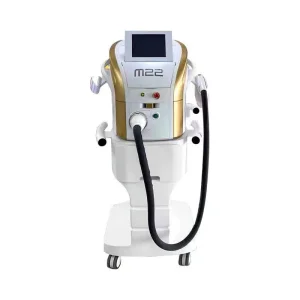
Essential technical verification criteria required when evaluating direct China laser facial machine factories during on-site or digital audits.
1. Optical Power Stability Testing
Verify that the manufacturer uses high-precision laser power meters (e.g., Coherent or Ophir) to measure energy decay across 10,000 continuous shots. Fluctuations should remain strictly below $\pm3\%$.
2. Thermal Dissipation Architecture
Ensure the internal chassis features pure copper radiators, semiconductor TEC cooling modules, and high-flow DC brushless water pumps to keep coolant temperatures under $35^\circ\text{C}$ during heavy clinical usage.
3. Cleanroom Assembly Protocol
Laser cavities and optical handpieces must be assembled in Class 10,000 (ISO 7) dust-free cleanrooms to prevent optical mirror contamination, beam scattering, and premature diode burn-out.
Expert technical answers addressing core concerns of B2B equipment buyers, clinic owners, and international importers.