1. Macro Industry Solutions & Global Alopecia Landscape
Alopecia—encompassing Androgenetic Alopecia (AGA), Telogen Effluvium (TE), and Alopecia Areata (AA)—has escalated into a ubiquitous medical and aesthetic concern across global demographics. Modern clinical insights indicate that hair loss affects up to 50% of males and 25% of females by age 50. In response, the non-invasive trichology market has experienced a paradigm shift away from purely pharmaceutical approaches toward bio-photonic interventions. As a premier OEM anti hair loss machine exporter and manufacturing partner, Shenzhen Aidiesin Industrial Co., Ltd. bridges the gap between high-level bio-optical research and scalable commercial production.
The macroeconomic market for hair restoration equipment is projected to surpass $5.8 Billion globally by 2030. To capitalize on this trajectory, medical aesthetics distributors, trichology clinic chains, and private-label brands require robust OEM/ODM engineering partners capable of delivering medical-grade diode stability, precise optical energy distribution, and customizable operational GUIs. Aidiesin's turnkey manufacturing ecosystems accommodate everything from full-body clinical hoods to ergonomic tabletop LLLT systems.
2. Technical Architecture & Bio-Photonic Engineering Principles
The efficacy of a professional anti hair loss machine hinges on strict optical parameters: optical wavelength precision, energy density ($J/cm^2$), laser diode beam spatial distribution, and heat dissipation dynamics.
650nm Red Cold Diode Laser
The 650nm monochromatic wavelength targets the mitochondria within dermal papilla cells. Photons are absorbed by Cytochrome C Oxidase (CCO), accelerating Adenosine Triphosphate (ATP) synthesis, elevating cellular metabolism, and driving resting (Telogen) follicles back into active growth (Anagen) phases.
Microcirculation Boost & Micro-currents
By stimulating the expression of Vascular Endothelial Growth Factor (VEGF) and Nitric Oxide (NO), low-level laser irradiation dilates micro-capillaries supplying the hair bulb. This enhances nutrient uptake and oxygenation while flushing out local Dihydrotestosterone (DHT) accumulations.
Smart Thermal & Driver Architecture
Professional OEM equipment features semiconductor thermoelectric cooling (TEC) coupled with pulse-width modulation (PWM) power supplies. This guarantees zero optical wavelength drift, preventing diode burnout and ensuring constant irradiance throughout 30-to-60-minute continuous therapy sessions.
System Comparison: Clinical LLLT vs. Alternative Hair Restoration Technologies
| Evaluation Parameter | Professional 650nm LLLT Laser | Pharmacological (Minoxidil/Finasteride) | Surgical Hair Transplantation |
|---|---|---|---|
| Mechanism of Action | Photobiomodulation & CCO ATP activation | Vasodilation & systemic 5-AR inhibition | Follicular unit extraction (FUE/FUT) graft relocation |
| Invasiveness & Pain | 100% Non-invasive / Zero pain | Non-invasive (Topical/Oral) | Invasive surgical procedure / Requires local anesthesia |
| Side Effect Profile | None reported in clinical trials | Scalp irritation, systemic hormonal fluctuation | Post-op scarring, infection risk, shock loss |
| Patient Compliance | High (Relaxing 20-min hands-free sessions) | Moderate to Low (Daily lifelong application) | Single/Dual procedure with long recovery period |
| Operational ROI for Clinics | Extremely High (Recurring package model) | Low (Retail margin on pharma product) | High single fee, limited repeat treatment value |
3. Industrial OEM/ODM Customization & Manufacturing Capabilities
Shenzhen Aidiesin Industrial Co., Ltd. delivers full-spectrum industrial design, tooling development, embedded software engineering, and cleanroom assembly. As a primary exporter of medical aesthetic equipment, we empower B2B buyers to bring proprietary anti-hair loss hardware to market swiftly and efficiently.
-
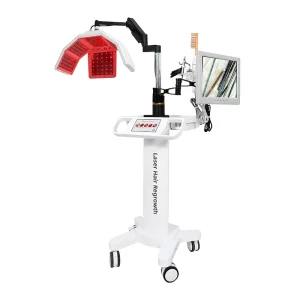
Hardware & Optical Chassis Engineering: Custom helmet geometry, multi-panel adjustable helmet arms, optical lens dispersion angles (60° to 120°), and medical-grade ABS/polycarbonate enclosures with customized Pantone paint finishes.
-
Diode Density & Wavelength Blending: Flexible configuration of 650nm red diode lasers combined with 808nm infrared diodes or 415nm anti-bacterial blue light LED modules to treat scalp inflammation and seborrheic dermatitis concurrently.
-
Software & Smart GUI Development: Multi-lingual capacitive touchscreen interfaces (Android OS driven), integrated client treatment history databases, automated dosage calculators, and remote telemetry for fleet management.
-
Private Label & Packaging Compliance: Custom laser-etched branding, localized user manuals, serialized UID tracking, and drop-test certified flight-case or heavy-duty export carton packaging.
4. Global Commercial Landscape & Regional Market Dynamics
Market requirements for trichology and hair regrowth equipment differ significantly across global regions due to local healthcare regulations, aesthetic trends, and purchasing power.
North America & Europe
High demand for medical-grade certifications (CE MDR, FDA 510k compliance). Clinics focus on high-throughput, multi-functional hair care stations that combine LLLT with scalp micro-needling, oxygen jet peeling, and diagnostic micro-cameras.
Middle East & GCC Region
Rapid growth driven by luxury medical spas and specialized hair transplant clinics. Emphasis is placed on premium aesthetics, large floor-standing clinical hoods with high laser diode counts (200+ to 400+ diodes), and gold-accented housing.
Asia-Pacific & LATAM
Strong demand for versatile desktop systems and compact multi-handle machines. OEM buyers prioritize cost-to-performance efficiency, easy maintenance, localized multi-language user interfaces, and robust power supply tolerance.
5. Deployment Scenarios & Clinical Application Protocols
Aidiesin's OEM anti-hair loss machinery is engineered to integrate seamlessly into diverse commercial environments:
Hair Transplant & Surgical Centers
Post-Operative Recovery Protocol: Low-level laser irradiation applied 48 to 72 hours post-FUE surgery reduces tissue inflammation, accelerates graft vascularization, prevents scalp edema, and speeds up scab shedding.
Medical Aesthetic Spas & Salons
Scalp Anti-Aging Treatment Packages: Combined with hair growth serums and hydrodermabrasion scalp cleansing, LLLT laser helmets serve as the flagship step in 12-week anti-hair loss subscription models.
Trichology & Dermatology Clinics
Targeted Alopecia Protocols: Precision multi-spectrum phototherapy protocols tailored to combat localized Alopecia Areata, female diffuse thinning, and early-stage male pattern baldness (Norwood Scale II–V).
6. Regulatory Compliance, Standards & Export Logistics
Navigating international regulatory frameworks is critical for medical and aesthetic device importers. Shenzhen Aidiesin Industrial Co., Ltd. operates under strict quality control management systems, providing comprehensive export documentation and compliance certificates.
-
ISO 13485:2016 Certified Manufacturing: Our production line adheres to international quality management standards for medical devices, ensuring batch-to-batch consistency and traceability.
-
International Safety Approvals: Full compliance with CE (LVD/EMC), RoHS, and IEC 60825-1 laser product safety standards, facilitating hassle-free customs clearance in over 80 countries.
-
Global Grid & Hardware Adaptability: Dual voltage switching (110V/220V, 50-60Hz), regional power plug customization (US, EU, UK, AU), and modular component engineering for rapid field servicing.
-
Comprehensive After-Sales Support: 12-to-24-month comprehensive warranties, spare parts dispatch within 48 hours, and direct engineer-to-engineer video technical assistance.
7. Future Technology Roadmap: Next-Gen Scalp Health Innovations
As photobiomodulation technology evolves, Aidiesin R&D teams are actively integrating next-generation innovations into our upcoming OEM machine revisions:
AI Trichoscopic Diagnostic Integration
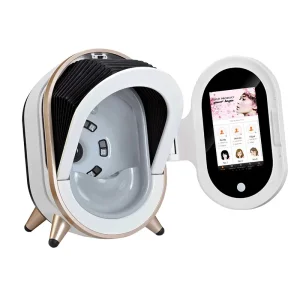
Onboard high-definition trichoscopy cameras equipped with AI vision models to auto-detect hair density per $cm^2$, follicular opening blockage, and scalp sebum levels, automatically outputting individualized laser dose recipes.
Dual-Wavelength Bio-Targeting
Simultaneous emission of 650nm (superficial papilla activation) and 808nm (deep tissue vascular stimulation) semiconductor laser light to maximize deep follicular recruitment without thermal build-up.
Electro-Photonic Synergy
Integrating bio-electric micro-current stimulation within the laser scalp hood contact nodes to increase scalp cell membrane permeability, facilitating deeper transdermal absorption of applied active growth factors.