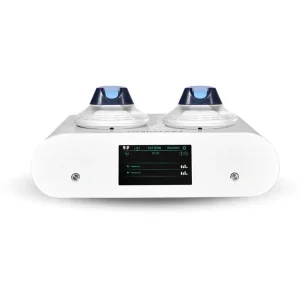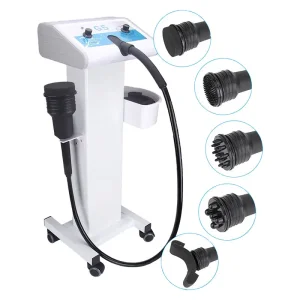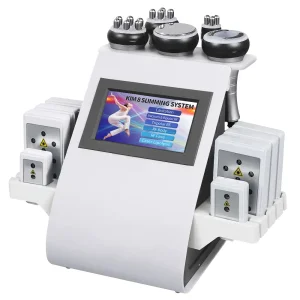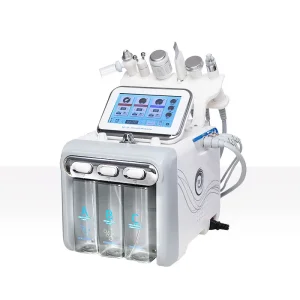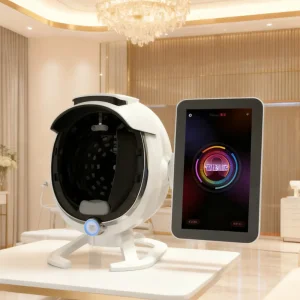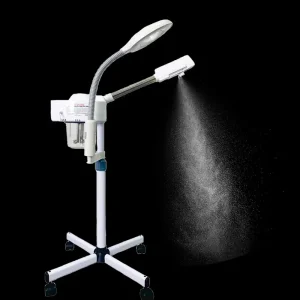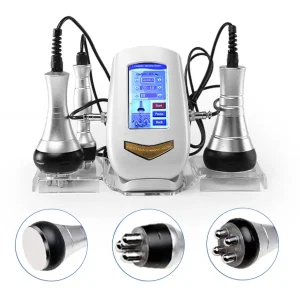
High-Precision Diagnostic & Aesthetic Hardware Systems
Explore our export-ready diagnostic platforms, bio-impedance moisture sensors, and clinical care systems engineered for global healthcare, cosmetic, and industrial distribution.
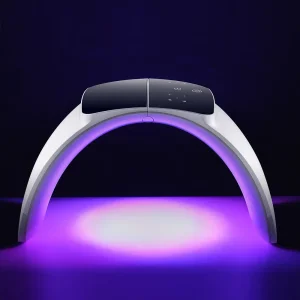
1. Executive Summary & Global Commercial Moisture Analysis Landscape
In modern clinical dermatology, biopharmaceutical quality assurance, advanced cosmetics R&D, and specialized material manufacturing, precise moisture quantification is no longer a secondary parameter—it is a critical indicator of barrier integrity, formulation stability, and efficacy. As leading custom moisture analyzer exporters and manufacturers, enterprise production facilities must bridge the gap between microscopic physical sensors and macro-level telemetry data.
The global demand for custom moisture measurement devices is undergoing a structural shift driven by three primary technological catalysts: the integration of Multi-Frequency Bio-Electrical Impedance Analysis (MF-BIA), non-invasive Near-Infrared (NIR) spectroscopic imaging, and AI-driven predictive algorithms. Industrial buyers and clinical brands require highly customized, repeatable, and non-destructive measurement systems tailored to specific substrates—ranging from human stratum corneum and scalp tissues to organic compounds and precision chemical powders.
From a market dynamics perspective, procurement teams are transitioning away from standardized, off-the-shelf desktop meters toward integrated, modular sensor probes that can be embedded into multi-functional diagnostic consoles, handheld clinical devices, and automated manufacturing lines. OEM/ODM customization capability stands as the single most critical competitive differentiator when selecting a manufacturing partner in China's advanced electronics hub.
2. Global Enterprise Procurement Demand & Sourcing Matrix
Through extensive user intent mining across international healthcare procurement networks, clinical B2B portals, and industrial testing consortia, enterprise buyers searching for custom moisture analyzer manufacturers typically operate under three specific search intents:
Dermatological & Clinical Intent
Clinics, medical spas, and skincare brands demand high-precision epidermal hydration monitors capable of evaluating Transepidermal Water Loss (TEWL), sebum-moisture ratios, and scalp barrier health. Probe tip materials must be biologically inert, sterilizable, and calibrated for human tissue permittivity.
Industrial Quality Control Intent
Manufacturers of powders, granules, polymers, and food matrices seek halogen or infrared loss-on-drying (LOD) analyzers or inline microwave capacitance sensors with automated weighing modules, RS485/Modbus connectivity, and rapid heating chambers.
Private-Label & OEM Device Intent
Aesthetic device brands and distributor networks require modular sensor boards, custom housing molds, customized color palettes, white-label mobile app software developments (iOS/Android SDKs), and specialized UI graphics.
Comparative Analysis of Primary Moisture Sensing Technologies
To guide enterprise procurement officers, the following technical comparison details the operational boundaries and performance metrics of modern moisture sensing modalities:
| Technology Vector | Bio-Electrical Impedance (BIA) | Capacitive Permittivity Sensing | Near-Infrared (NIR) Optical | Loss-On-Drying (Halogen LOD) |
|---|---|---|---|---|
| Primary Target Medium | Human tissue, stratum corneum, scalp | Solid materials, film, superficial skin layer | Multi-layer skin, liquid & emulsions | Bulk powders, agricultural & chemical products |
| Measurement Time | < 0.2 Seconds | < 0.1 Seconds | 1.0 - 3.0 Seconds | 3 - 15 Minutes |
| Destructive / Non-Destructive | Non-Destructive | Non-Destructive | Non-Destructive | Destructive (Thermal Evaporation) |
| OEM Customization Level | High (Electrode shape & frequency) | Ultra-High (PCB trace geometry) | Medium (Optical filter band) | Medium (Chamber & load cell) |
| Integration Interface | UART / I2C / BLE 5.2 | Analog Voltage / I2C | USB 3.0 / MIPI CSI-2 | RS232 / Modbus TCP / USB |
3. Technical Engineering Architecture & OEM/ODM Roadmap
Building an enterprise-grade custom moisture analyzer requires multi-disciplinary engineering coordination across electronic design, mechanical tooling, sensor calibration, and software algorithm development. As experienced manufacturers based in Shenzhen's advanced technology corridor, our R&D pipeline follows a rigorous five-stage architectural workflow:
Stage I: Sensor Hardware & Probe Engineering
Customization begins at the physical contact point. We engineer gold-plated coaxial spring probes, bio-compatible stainless steel micro-electrodes, or sapphire-glass optical windows. PCB layouts feature high-shielding ground planes to eliminate ambient electromagnetic interference (EMI) and 24-bit Analog-to-Digital Converters (ADC) for ultra-low noise signal conversion.
Stage II: Algorithmic Calibration & Signal Processing
Permittivity ($\varepsilon$) and impedance ($Z$) vary non-linearly with temperature and pressure. Our firmware embeds active thermistor feedback loops and pressure-sensing micro-switches to ensure measurements trigger only under consistent, calibrated contact force (e.g., 2.5 N ± 0.2 N), eliminating operator-induced variance.
Stage III: Multi-Spectral & AI Data Fusion
For advanced skin and tissue analysis platforms, we pair bio-impedance sensors with multi-spectral polarized imaging (RGB, UV, CPL). Neural network models run on-device or cloud-side to correlate surface hydration, deep dermal moisture retention, oil concentration, and pore barrier health into actionable diagnostic reports.
Stage IV: Industrial Tooling & Enclosure Design
Industrial housing options include ergonomic hand-held enclosures molded from medical-grade ABS/PC plastics, IP65 water-resistant sealing, or full stainless steel chassis for harsh industrial quality control environments. Custom injection molding and laser branding ensure brand identity compliance.
Stage V: Telemetry, SDK & System Integration
Hardware is connected to modern software ecosystems via Bluetooth Low Energy (BLE 5.2), Wi-Fi 6, or wired USB/RS485. We provide complete iOS/Android software development kits (SDKs), API documentation, and cloud database connectors for seamless enterprise integration.
4. Technical Roadmap & Future Outlook (2025–2030)
As moisture diagnostic hardware evolves, exporters and manufacturers must anticipate technological shifts to maintain market leadership. Key engineering milestones driving the next generation of custom moisture analyzers include:
- Sub-Dermal Capacitance Depth Profiling: Transitioning from single-layer surface capacitive readings to multi-frequency array sensing capable of mapping hydration gradients across the stratum corneum, epidermis, and upper dermis simultaneously.
- Miniaturized Quantum-Dot NIR Spectroscopy: Replacing bulky optical filters with chip-scale quantum dot spectrometers, allowing handheld diagnostic tools to measure moisture absorption bands (970nm and 1450nm) at sub-millimeter spatial resolutions.
- Self-Calibrating Micro-Fluidic Probes: Integrating automated micro-calibration chambers within the device dock to verify sensor accuracy before every diagnostic scan, eliminating manual calibration drift in clinical settings.
5. Global Regulatory Compliance, Standards & Localization Support
Exporting complex diagnostic equipment into North American, European, Asia-Pacific, and Latin American markets requires total alignment with regional safety, electromagnetic, and biological compliance frameworks. Our manufacturing operations strictly adhere to international quality assurance standards:
International Quality & Safety Certifications
All manufacturing facilities operate under ISO 13485 (Medical Devices) and ISO 9001 quality management systems. Product lines maintain full compliance with CE-MDD/MDR, FDA Class I/II registration guidelines, RoHS 2.0 hazardous substance restrictions, and REACH chemical protocols.
Electromagnetic Compatibility (EMC & LVD)
Devices are engineered to pass rigorous IEC 60601-1 (Electrical Safety) and IEC 60601-1-2 (Electromagnetic Compatibility) testing, ensuring zero radio interference with surrounding hospital, laboratory, or clinical equipment.
Localization & Multi-Voltage Engineering
Global deployment requires flexible localization. We provide universal power supply modules (100V–240V AC, 50/60Hz), regional plug adaptations (EU, US, UK, AU), localized screen interfaces (supporting 15+ languages), and region-specific wireless frequency certifications (FCC, CE-RED, TELEC, SRRC).
6. Enterprise Sourcing & Technical Q&A
Clear, definitive answers to high-intent procurement questions asked by international buyers, medical distributors, and OEM brand partners:
For standard private-label branding (logo printing, custom packaging, localized user manuals), our typical MOQ starts at 50 to 100 units. For full ODM hardware customization (custom PCB layout, specialized sensor probe tooling, and bespoke enclosure molds), MOQs typically range from 500 to 1,000 units depending on plastic injection complexity.
Accuracy is guaranteed through multi-point calibration curves loaded directly into the device MCU. For dermatological applications, probes use dual-frequency bio-impedance (10 kHz and 100 kHz) to separate superficial contact capacitance from true intracellular/extracellular fluid impedance. For industrial materials, custom calibration matrices are built using gravimetric loss-on-drying reference standards.
Yes. We supply fully documented native iOS (Swift/Objective-C) and Android (Kotlin/Java) SDKs, along with Flutter/React Native bridges. Software developers can seamlessly receive real-time impedance readings, contact state notifications, battery telemetry, and automated diagnostic calculations over encrypted Bluetooth LE channels.
Every manufactured unit undergoes 100% automated optical inspection (AOI) for PCB assemblies, 72-hour continuous thermal aging burn-in, contact micro-switch durability cycles (50,000 press rating), and dual-point calibration verification using standard impedance reference blocks prior to final protective export packaging.
Standard OEM logo integration takes approximately 10 to 14 business days. For complete ODM custom hardware development: Prototype design and 3D working samples require 3 to 4 weeks; tooling mold creation takes 4 to 6 weeks; mass production and compliance testing take 3 to 4 weeks following final golden sample approval.
Explore Additional Professional Body & Skin Care Solutions
Review our full range of certified aesthetic hardware, microdermabrasion platforms, and EMS slimming systems for global distribution.